Originally
the air wing was called an air group and had a name, not a number;
the air group title was based upon the carrier it was assigned to.
For instance, an air group on CV-3 USS Saratoga would have simply
been called the "Saratoga Air Group". In 1942, air groups
lost the carrier name and began to be numbered.
The number given to
each air group came from the hull number of the carrier to which it
was assigned. i.e. CAG-3 for the "Saratoga Air Group" on
CV-3 USS Saratoga, CAG-14 for the "Ticonderoga Air Group"
on CV-14 USS Ticonderoga, etc. It is from this original term for the
air wing that the term “CAG” comes from for the commanding
officer (it literally meaning “Commander Air Group”) of
an air wing of today. The CAG is typically an O-6 Captain and experienced naval
aviator who, when embarked, reports to the Rear Admiral in command
of the strike group.
This numbering scheme remained in use until late
1948 when all CAGs (the air groups, not the commanding officers) were
renamed as CVGs and as they started to move from carrier to carrier,
they lost the relationship to the carrier hull number. As an example of the new naming scheme, in 1951, CV-9 USS
Essex deployed on a WESTPAC cruise not with CVG-9 but CVG-5 as her
airwing.
There are currently ten CVWs (five on the east coast and five
on the west; although one of the west coast airwings is permanently forward deployed
to Japan) and one Tactical Support Wing. A modern CVW, more capable and packing
more punch than many air forces, has roughly 2,500 personnel and consists
of roughly 60-65 aircraft from up to nine front line squadrons.
A modern Air Wing consists of the following:
Squadron |
Aircraft |
Typical
role |
VFA |
|
Strike
fighter
Air wing tanker |
VFA |
|
Strike
fighter
Air wing tanker
|
VFA |
|
Strike
fighter |
VFA |
|
Strike
fighter |
VAQ |
|
Tactical
electronic warfare
SEAD |
VAW |
|
Airborne
early warning |
HSC |
|
SAR / CSAR
Logistics (VERTREP) |
HSM |
|
ASW / ASuW |
VRC Det |
2x C-2A Greyhound
 |
Logistics
support |
A CVW is literally a self
contained air force that can handle threats at sea, in the air and
on the ground by night and day and in all sorts of weather. Multi-element
strike packages can fight their way in, hit their targets with the
latest in precision munitions, fight their way out and all the while
have electronic support to suppress enemy defences whilst helicopters
stand ready for SAR. Other embarked helicopters could also be conducting
maritime security operations such as providing a means to stop and/or
board a suspect vessel. Air wing tankers (F/A-18E/F)
don’t have the high offload ability or range of the “big
wing” tankers such as KC-135s so hang around the carrier
to allow returning aircraft that have to go around or that have 'bolted' (missed
a wire) the opportunity to take on board much needed fuel to get back
home.
Whilst
most aircraft carry small air wing emblems somewhere about their fuselage
or tails, it is the tailcodes that clearly identify the air wing with
the first letter designating which coast the air wing hails from.
An 'A' prefix, i.e. AC, signifies East Coast (air wing headquarters
at NAS Oceana, VA) and an 'N' prefix, i.e. NG, signifies West Coast
(air wing headquarters at NAS Lemoore, CA). All active fleet EA-6Bs and EA-18Gs, be they assigned to an east or west coast air
wing, call NAS Whidbey Island, Washington their home.
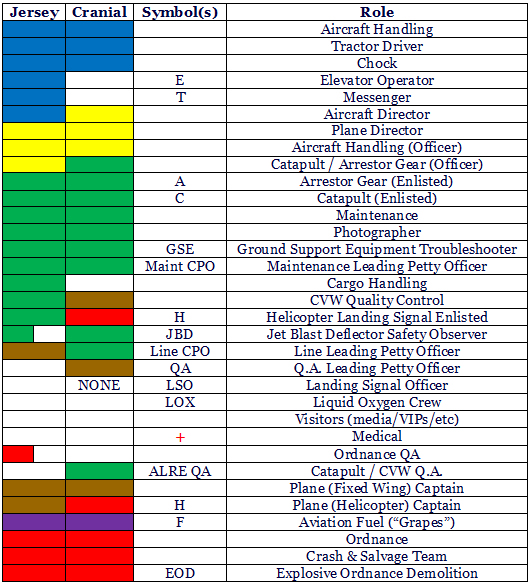
Some
of the many Air Wing personnel work on the flightdeck to ensure smooth
running of flight operations and have clearly defined roles to play.
To determine, at a glance, what each person's role is, they wear colour
coded uniforms which conform to fleet wide regulations.